 El Coco
 Drone photos give a real estate buyer context: where the property is and what is around it. With distance markers on screen, the buyer sees how far it is to the beach, the town and the airport before they book a flight. We could not find a study that proves aerials sell homes faster. They pay for themselves when the setting is part of the price.
What a buyer sees from the air
A buyer looking at a listing from Toronto or Denver has one question the interior photos can't answer. Where is this, and what is around it? From above they see the shape of the lot, the road in, the neighbours' roofs and how far it is to the water.
We go one step further on our shoots. We build visual markers into the footage that show the distance to the points a buyer cares about: the beach, the town, the airport. The markers sit on the frame, so the buyer reads "beach" and a distance while they watch the property in its setting. A listing that says "five minutes to the beach" asks for trust. A line drawn from the roof to the sand shows it.
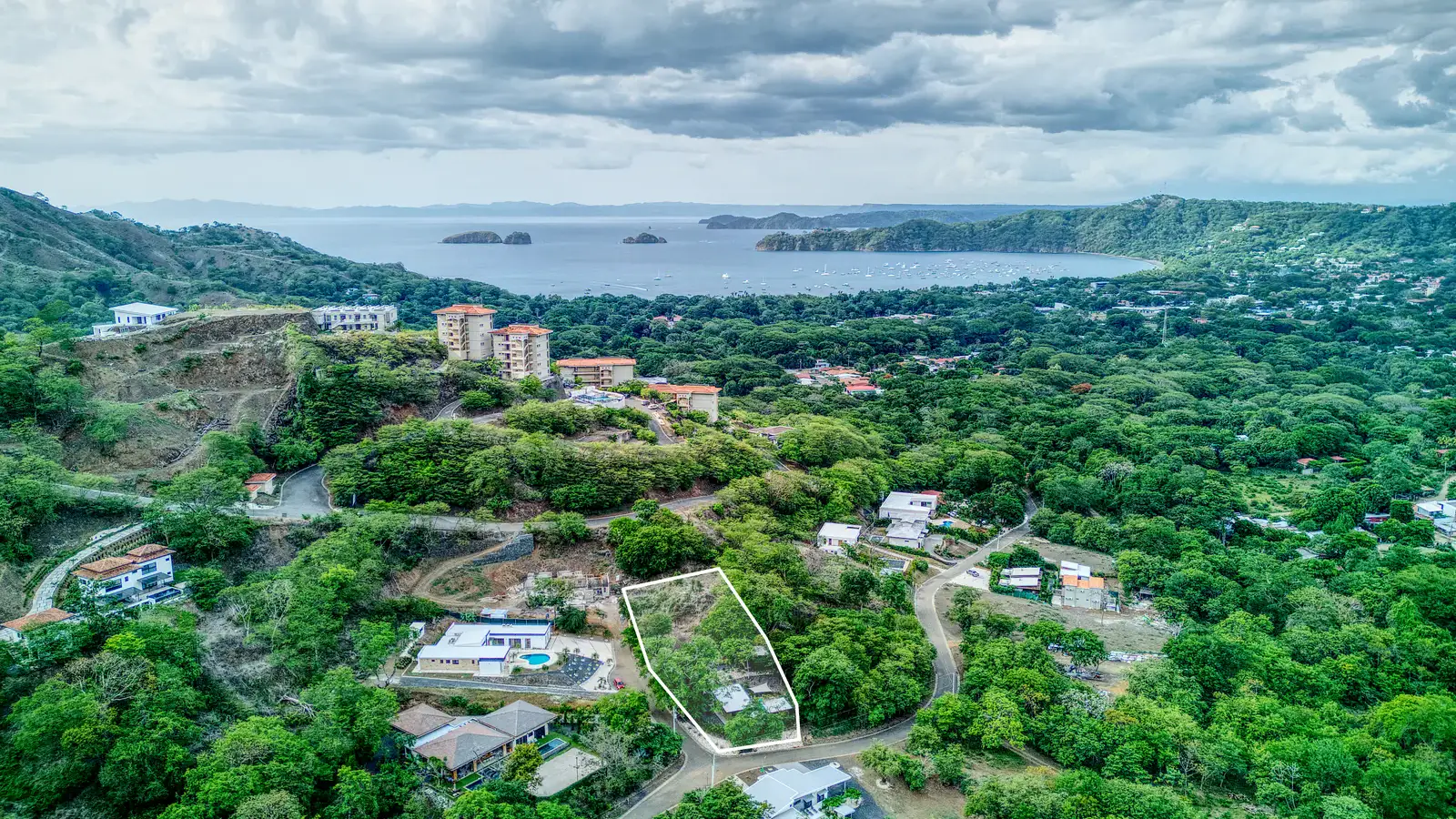
In Guanacaste that context counts for more than usual. Many buyers here live in Canada or the US and meet the property on a phone weeks before they stand in it. A listing that says "ocean view" makes them ask how much ocean, from which room, over whose roof. One slow pass from the terrace out toward the coast answers that in ten seconds.
The frame owners like most
The still clients love is the one that shows the entire property in one frame. House, pool, garden, driveway and boundary, all at once. On the ground that takes a dozen photos and the buyer still has to piece them together. From the air it is one picture.
We have shot and edited aerials over Playa Hermosa, Jaco and Tamarindo. A single property needs a tighter list than a coastline does. Ask your pilot for these frames by name:
- The whole property in one still, from high enough to show the boundary
- A pull back from the front door to the street and the hills behind it
- The line from the property to the nearest beach or town, with distance markers
- For an empty lot, the view from the height where the living room would be
The last one matters most on land. A buyer looking at a bare hillside lot is paying for a view they cannot stand in yet, and a drone hovering at second-floor height is the only way to show it before anything is built.
When it is worth paying for
Drone footage earns its cost when the setting is part of the price. It adds little when the buyer is paying for the inside.
Book it for:
- View lots and hillside homes, where the view is what the buyer pays for
- Raw land and larger parcels, where size and access come first
- Homes a short walk from the beach
- Gated communities with shared pools, roads or trails
Think twice for a condo unit in the middle of a building, or a house on a tight street where the roof is the best angle. Check the map first for anything within 8 km of an airport or airstrip. Costa Rica's aviation authority, the DGAC, bars flights that close to an aerodrome unless it grants permission. A quote that ignores the distance may not fly.
For a condo, ask whether the operator will add one or two aerials of the building and the beach to an interior shoot. A full aerial package spent on a rooftop is money the inside of the unit needed more.
When to shoot in Guanacaste
The season changes the footage more than the drone does. From about December to April the dry season turns the hills brown. From May the green season comes in. The same hillside goes deep green within weeks, and afternoon storms roll in.
A buyer who visits in March will see brown hills, so a listing shot only in September can feel like a bait and switch. Show the season the buyer is likely to arrive in. If the listing may run across both seasons, settle the cost of a second flight when you book. Agreeing it then is easier than arranging it in a hurry once the hills turn.
What the footage does after the listing
A drone shoot is usually priced as one listing's worth of photos, and once the home sells the files sit in a folder. Before you pay, ask what the footage can still do after closing.
Who owns the files. If the operator keeps the masters, ask what your license covers. Does it end with the listing? Does it pass to the buyer at closing? The question that saves money later is re-licensing. If the property comes back on the market unchanged, can the next seller license the same footage for less than a reshoot? On our shoots the studio keeps the masters, which is what makes a later re-license possible. A license that outlives the sale turns one shoot into footage for the next one.
The commission math
Footage an owner already holds is something to bargain with a listing agent. The line is short: "We already have our footage. Knock 0.5% off commission."
Take a $1,000 media package as a worked example. On a $400,000 sale, 0.5% is $2,000. An owner who pays for the footage and trades it for half a point comes out $1,000 ahead at closing. The agent gets finished media without booking a shoot.
The math moves with the price. On a $250,000 condo, 0.5% is $1,250, which is thin. The condo advice above already says to spend less in the air. On a $900,000 view home it is $4,500. Below $200,000, half a point is less than a $1,000 package. There the trade stops paying.
Agents can say no. The point is that footage paid for up front is yours to put on the table. To cut the same shoot into Reels and Shorts, see real estate video and social.
Questions
Do drone photos help a house sell faster?
No study we could find shows it. They do help a buyer who cannot visit yet judge the location, which can save a wasted showing.
Is drone footage worth it for a condo?
Usually only a little. One or two aerials of the building and the beach are enough. Put the rest of the budget into interior photos and a walk-through video.
Can my agent fly their own drone for the listing?
In Costa Rica, paid drone work needs a DGAC operating certificate and a licensed pilot. Recreational flying needs no approval, but the DGAC says it cannot be used for paid or commercial work. Marketing a listing is commercial work in our view. Ask to see the certificate first.
Who owns the drone footage after the sale?
It depends on the contract, so read it before you pay. Ask who keeps the masters and whether your license ends with the listing. Then ask if a later seller can re-license the footage instead of paying for a reshoot.
You run the property or the business. Our job is the digital work behind the scenes: the aerials, the edit and the page they live on. All of it exists so the most eyes land on what you are selling.